World State Tokens
16 policy-native tokens encode a spatially grounded summary of the current physical scene.
Efficient 3D Gaussian world modeling for robotics
A compact, policy-native world model for physically grounded Vision-Language-Action control.
Tuojing Intelligence · University of Chinese Academy of Sciences · Institute of Automation, CAS
Tsinghua University · HKUST (Guangzhou) · NTU · Beihang University · Carnegie Mellon University · HKU
* Equal contribution † Corresponding author
The upgrade
GaussianDream++ internalizes world modeling inside the native VLA pathway. It preserves the benefits of current-world reconstruction and future prediction while removing the dedicated runtime geometry pathway.
01 / Method
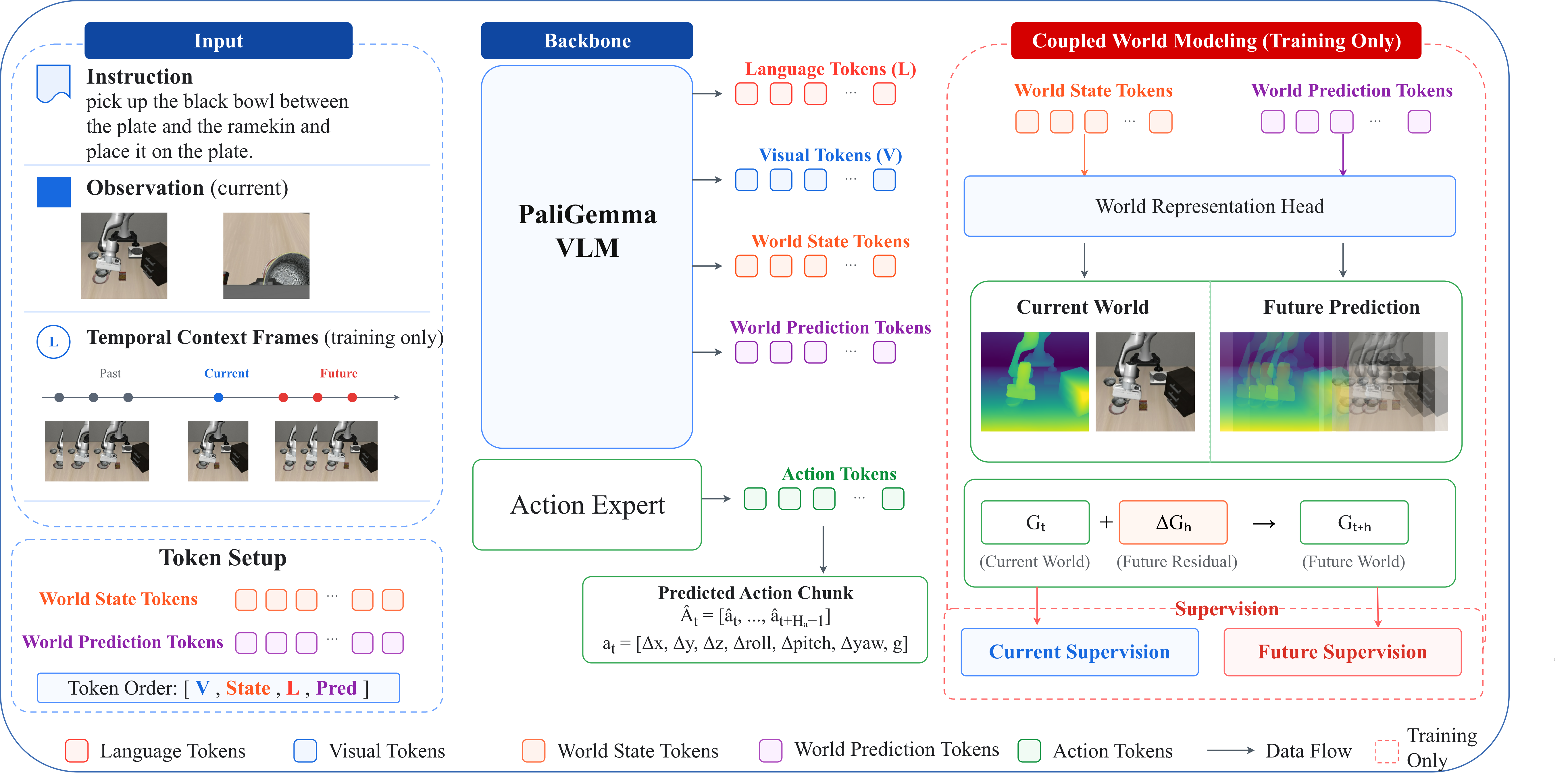
Two role-specific token groups are contextualized with visual and language tokens, then directly condition the Action Expert. Dense Gaussian decoding exists only during training.
16 policy-native tokens encode a spatially grounded summary of the current physical scene.
4 compact tokens represent short-horizon scene evolution and interaction-relevant motion.
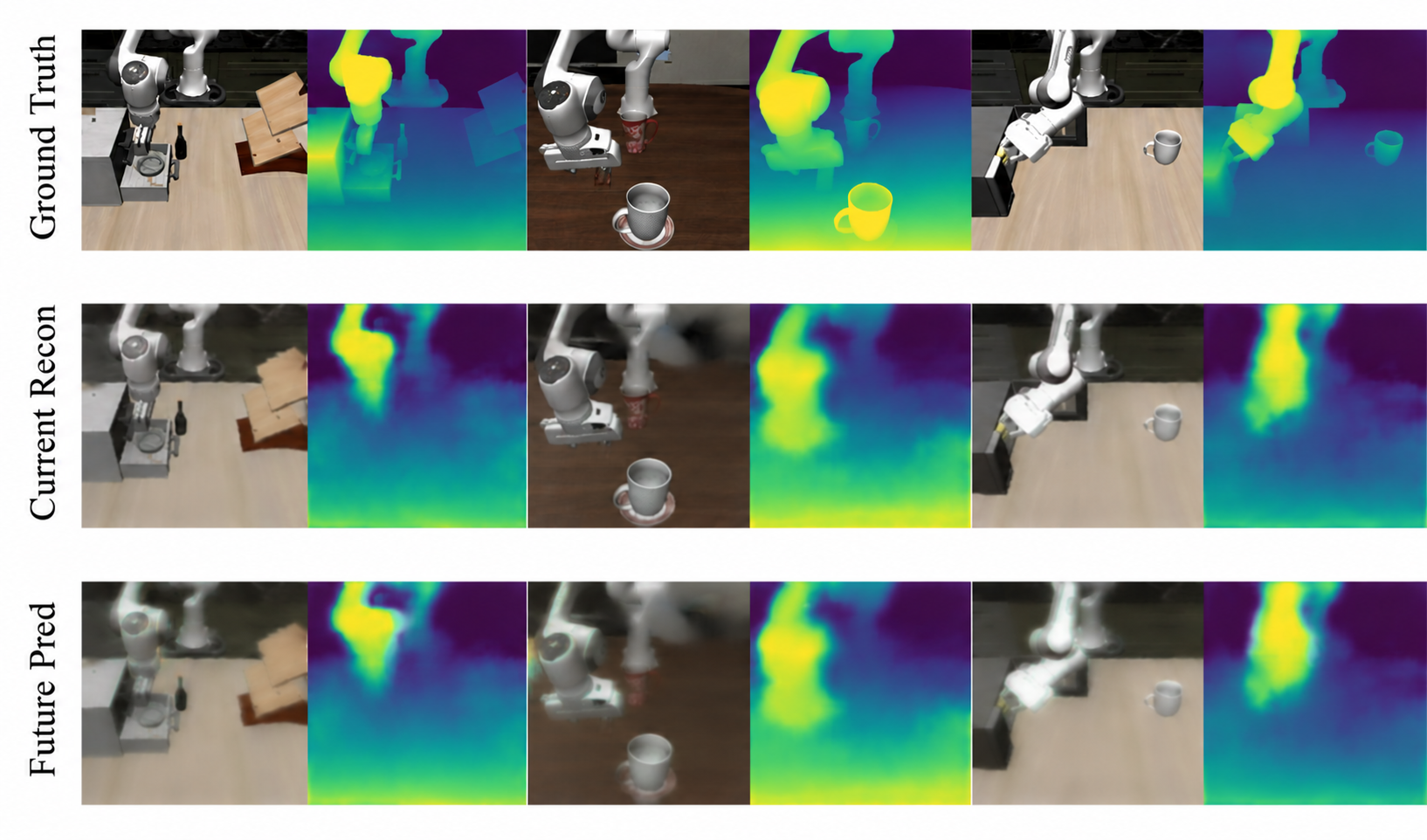
A lightweight World Representation Head decodes Current World and Future Prediction over shared Gaussian primitives.
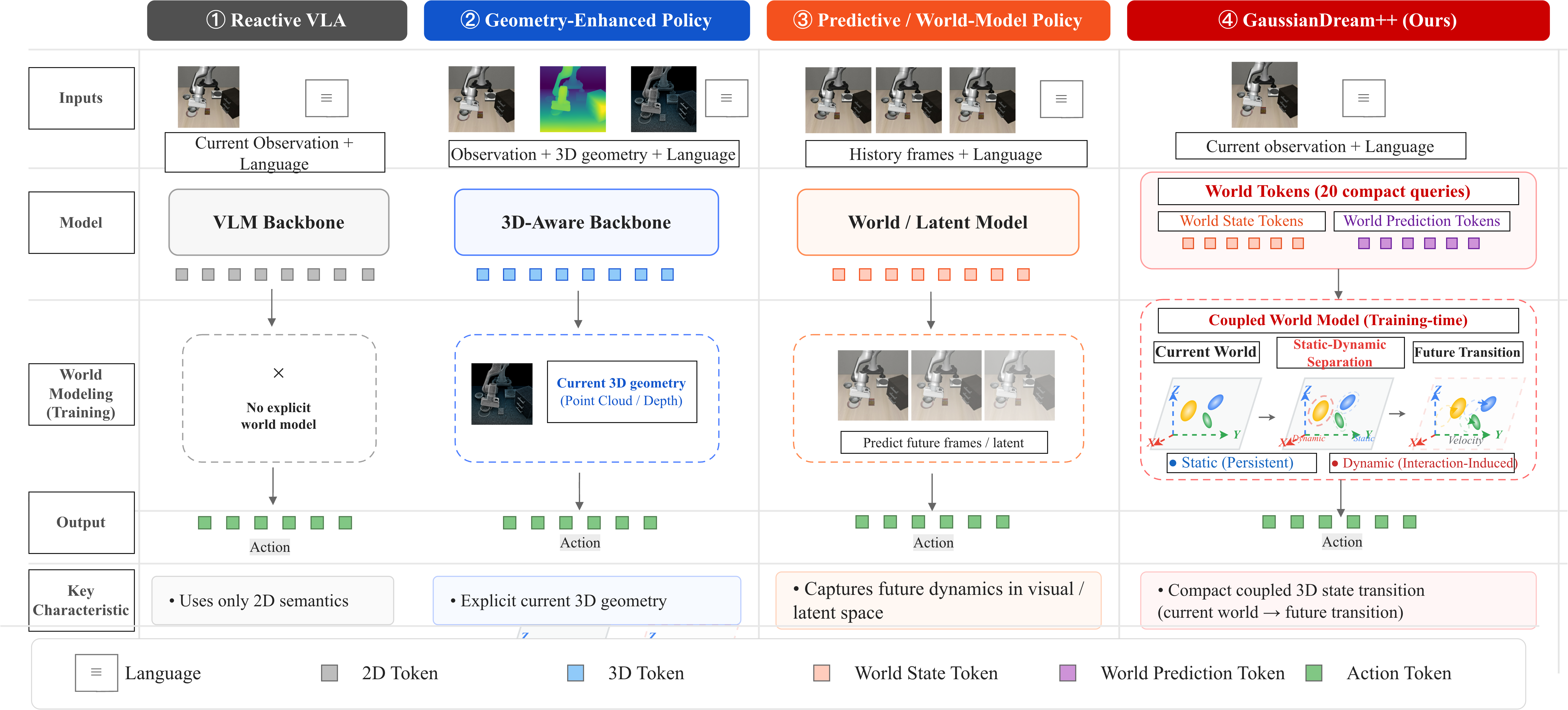
Asymmetric by design
During training, the World Representation Head converts token representations into geometry, appearance, visibility, and motion targets. At deployment, the dense branch disappears and the same tokens continue to condition action generation through native attention.
02 / Results
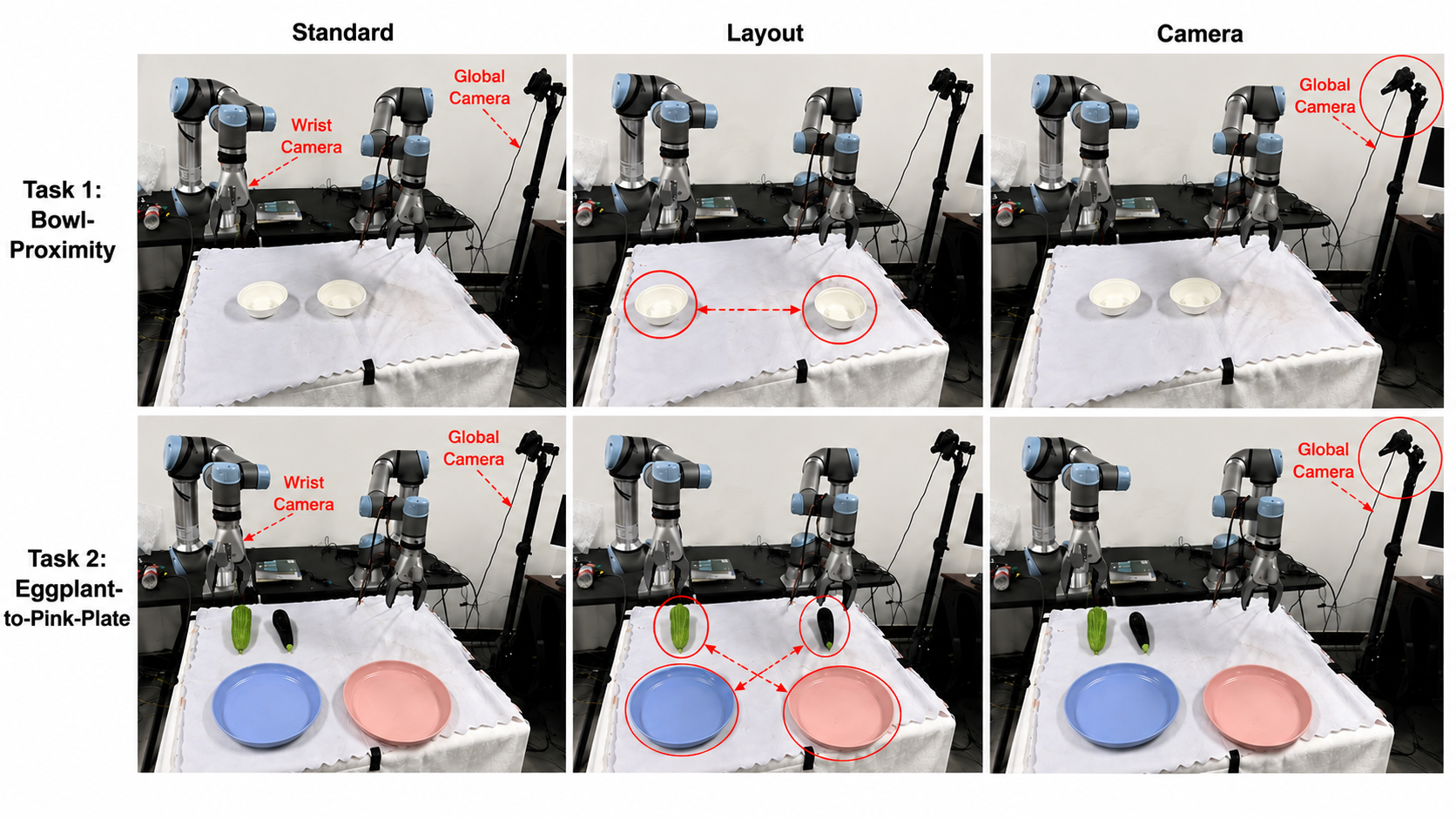
Under the matched GaussianDream-family protocol, GaussianDream++ improves both standard manipulation and zero-shot robustness, especially under camera and layout shifts.
No runtime world model
Removed after training
World Representation Head · Gaussian renderer · auxiliary branches · runtime VGGT/TGE pathway
Kept at deployment
20 world tokens inside the PaliGemma prefix, directly conditioning the Action Expert
03 / Resources
@article{gaussiandreamplusplus,
  title   = {GaussianDream++: Efficient 3D Gaussian World Modeling for Robotic Manipulation},
  author  = {Jiang, Yuqing and Zhang, Zijian and Zhou, Weitao and He, Junjie and Yang, Lei and Qing, Haifang and Liu, Si and Zhao, Ding and Luo, Ping and Yu, Haibao},
  year    = {2026},
  url     = {https://github.com/TuojingAI/GaussianDream}
}