Build the teacher
Frozen geometry and vision foundation models provide depth, camera parameters, and dense semantic features from synchronized views.
Training-time 3D Gaussian enhancement for robotics
Distilling Geometry and Semantics from 3D Gaussian Fields into World-Action Models
Tuojing Intelligence · University of Chinese Academy of Sciences · Institute of Automation, CAS
Tsinghua University · Simple AI · HIT Shenzhen · Shanghai Jiao Tong University · Zhejiang University · HKU
* Equal contribution † Corresponding author
The idea
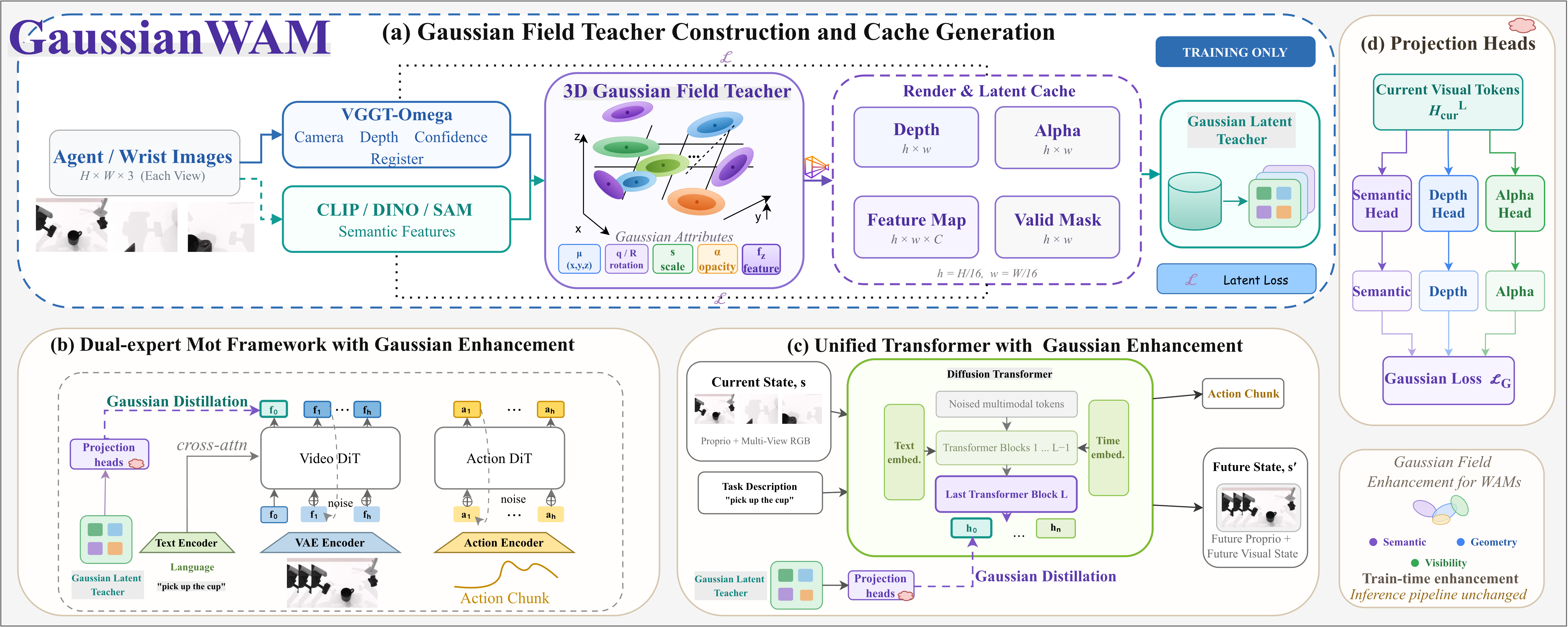
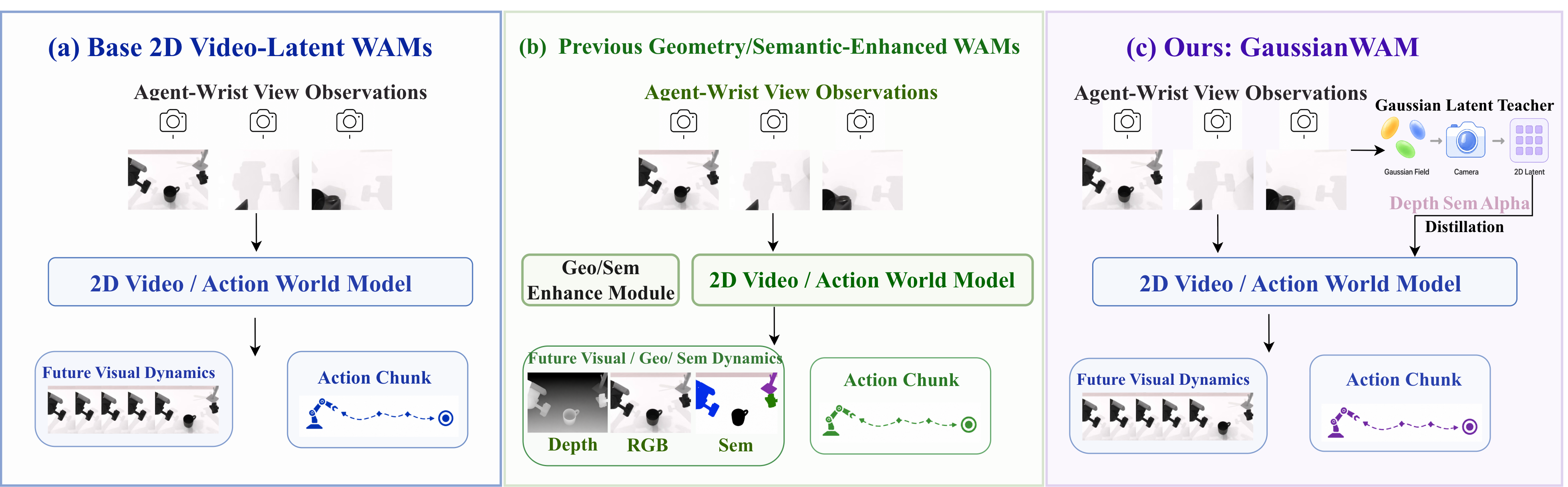
GaussianWAM uses a 3D Gaussian field to spatially align geometric and visual-semantic supervision during training. The Gaussian teacher, foundation models, and auxiliary heads are removed before deployment, leaving the original inference path unchanged.
01 / Method
Multi-view observations are lifted into a shared 3D coordinate system. Gaussian rendering turns that field into dense targets aligned with the WAM visual tokens.
Frozen geometry and vision foundation models provide depth, camera parameters, and dense semantic features from synchronized views.
Geometry and semantics are attached to the same Gaussian primitives, creating a spatially coherent teacher representation.
Rendered semantic, depth, and alpha targets supervise current-observation representations during policy training.
Spatially grounded representations
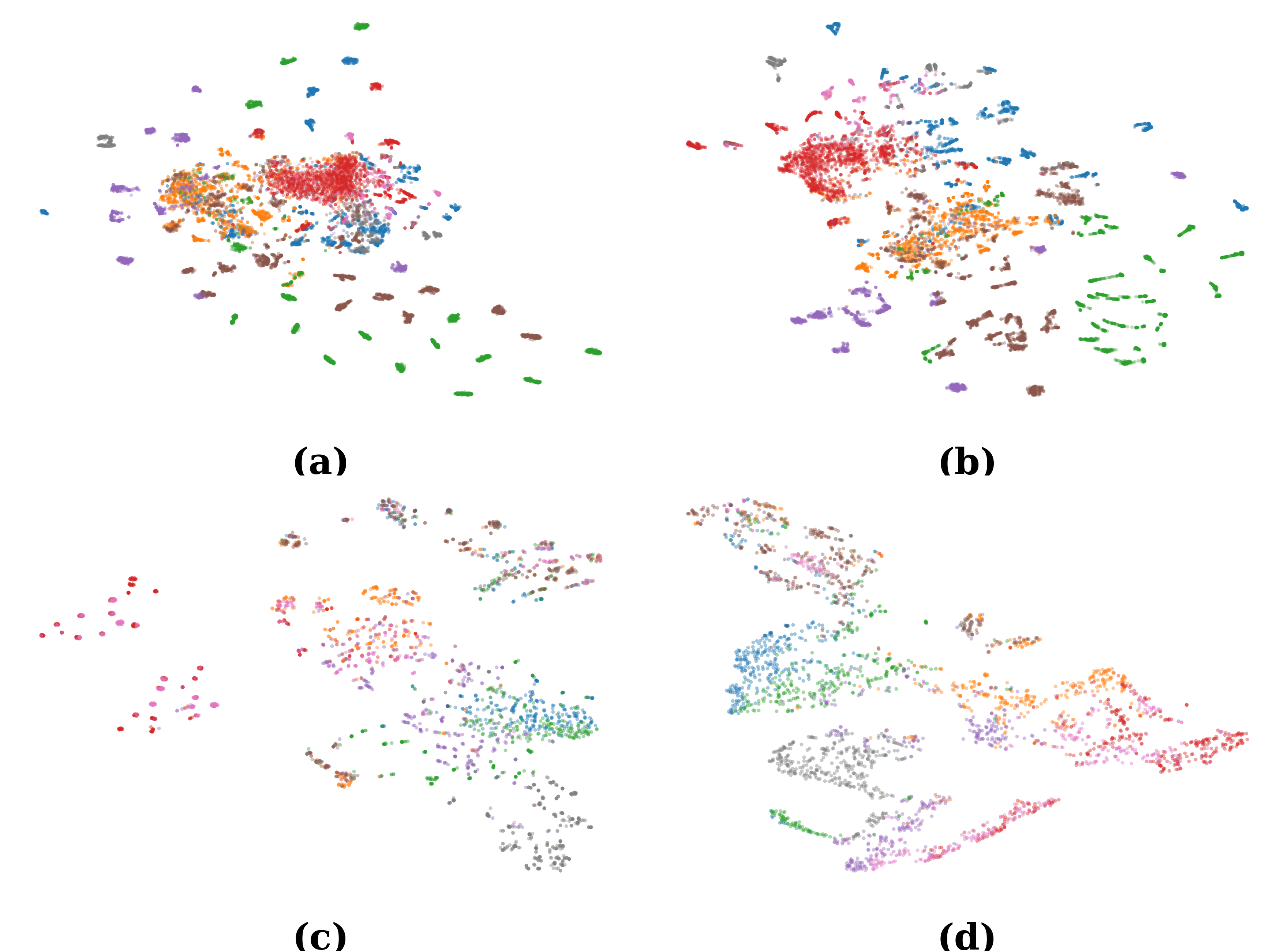
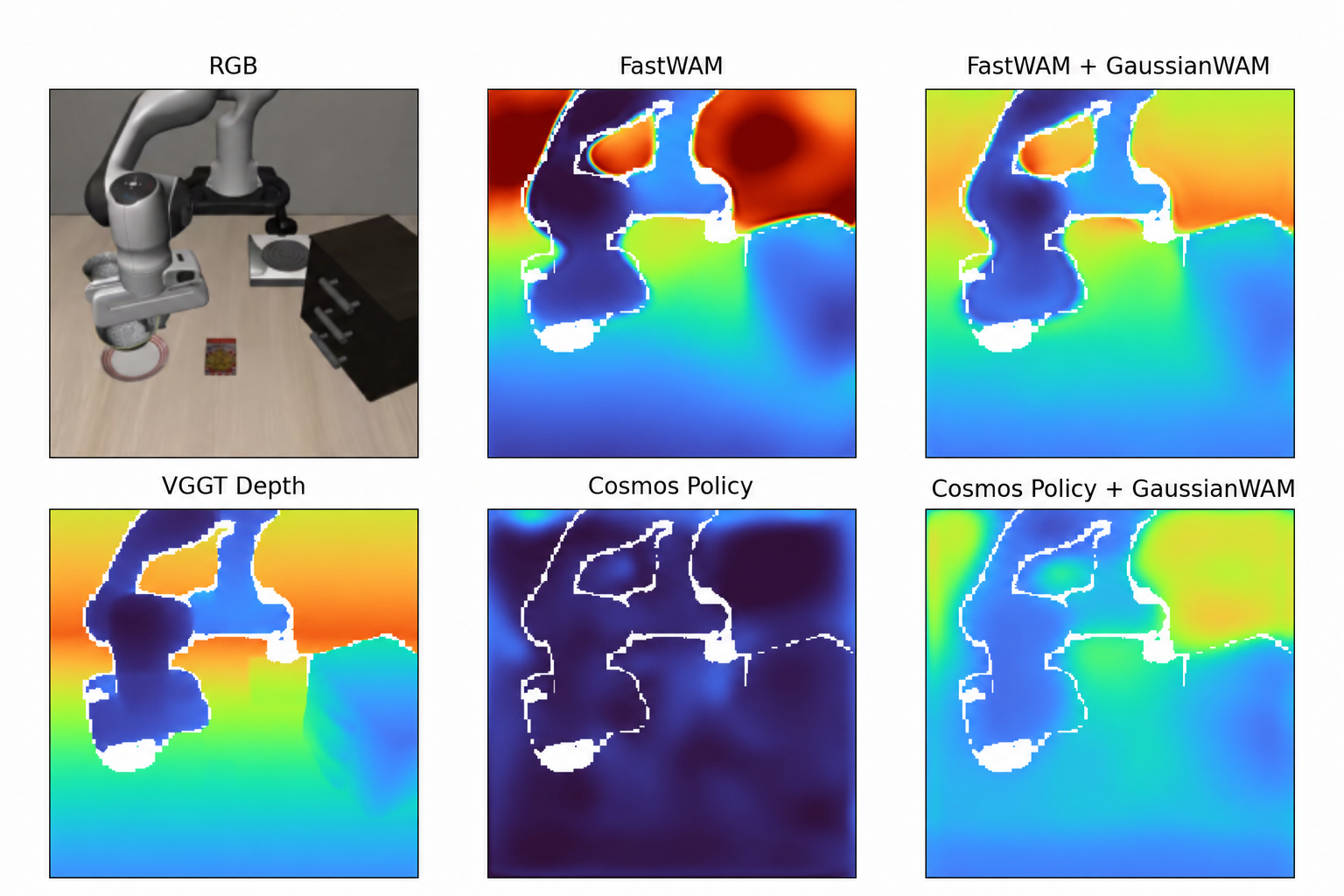
Rather than distilling heterogeneous teachers independently in 2D, GaussianWAM associates semantic features with the geometry that supports them. The resulting supervision encourages action-relevant visual tokens to retain object-level meaning and cross-view structure.
02 / Results
GaussianWAM improves both a dual-expert FastWAM-style model and a unified Cosmos Policy transformer, with the strongest gain under the LIBERO-Plus distribution shift.
Training only
During training
Gaussian field · VGGT · CLIP · auxiliary heads
During inference
Original WAM forward path · no extra modules · no extra compute
03 / Resources
@article{gaussianwam,
  title   = {GaussianWAM: Distilling Geometry and Semantics from 3D Gaussian Fields into World-Action Models},
  author  = {Zhang, Zijian and Jiang, Yuqing and Zhou, Weitao and Li, Minglei and Zhang, Jinhao and Mu, Yao and Li, Xiaofan and Zhao, Hao and Yu, Haibao},
  year    = {2026},
  url     = {https://github.com/TuojingAI/GaussianWAM}
}